
There is a quiet revolution happening in marketing budgets right now. Brands that used to spend $5,000 on a single product video are producing 20 versions of that same video for a fraction of the cost. They are testing different hooks, different faces, different languages. And they are doing it in days, not weeks.
The technology driving this shift is AI UGC video. And if you have not started paying attention to it, your competitors almost certainly have.
What Is an AI UGC Video?
User-generated content has always been marketing gold. Real people talking about real products. No polish, no perfection. Just honest reactions that consumers trust far more than a billboard.
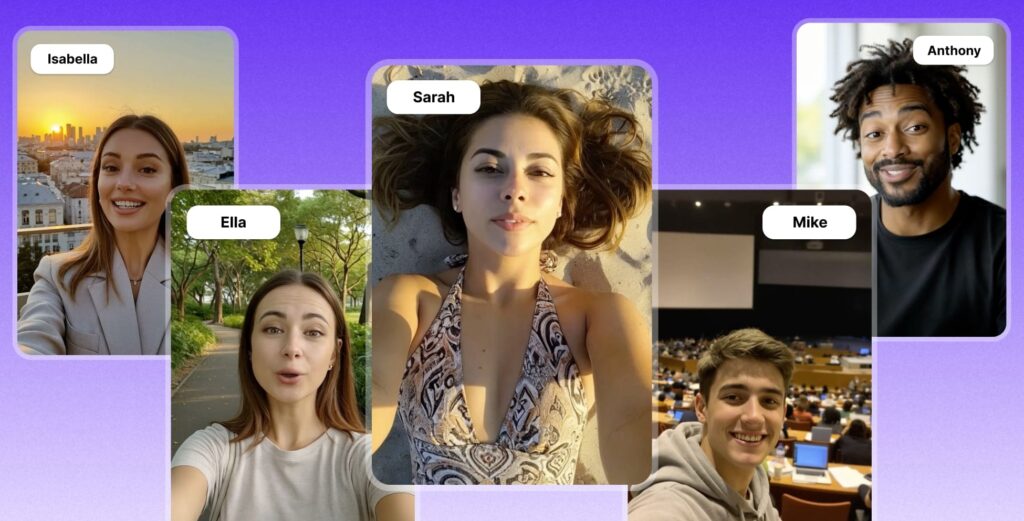
AI UGC videos take that same energy and rebuild it from the ground up using artificial intelligence. Instead of sourcing creators, negotiating rates, waiting on deliveries, and editing raw footage, brands can generate videos featuring realistic AI avatars that speak directly to camera. The result looks and feels like authentic creator content. But it is produced in a fraction of the time.
Traditional UGC relies on real people. That means real schedules, real opinions, and real production unpredictability. AI-generated UGC gives brands control without sacrificing the authentic, conversational aesthetic that makes UGC so effective in the first place.
This is not about replacing human creativity. It is about removing the logistical ceiling that used to limit how much content a brand could produce.
How AI UGC Videos Work
The process is more straightforward than most people expect. Here is what happens from brief to finished video.
Script Creation
Everything starts with the script. A good AI UGC video begins with a tight, conversational script built around the audience’s actual pain points. This is where the real creative work lives. The script defines the hook, the value proposition, and the call to action.
Avatar Selection
Once the script is ready, brands choose an AI avatar. These are photorealistic digital humans that can speak, gesture, and express emotion. Most platforms offer a library of diverse avatars across ages, ethnicities, and presentation styles. Some platforms allow brands to create custom avatars entirely.
Voice Generation
The script is fed into an AI voice engine that generates natural-sounding speech. Tone, pacing, and even emotional inflection can be adjusted. For brands targeting global markets, most platforms support multilingual generation, which means the same video can be localized for Spanish, French, Portuguese, or Mandarin without hiring a new creator for each language.
Video Rendering and Editing
The avatar, voice, and visual elements are combined and rendered. Background footage, on-screen text, branded graphics, and music are layered in. The output is a finished video ready for platform-specific formatting whether that is a vertical cut for TikTok or a widescreen version for YouTube.
Publishing
Finished videos can be exported and published directly to ad platforms, social channels, landing pages, or email campaigns. The entire pipeline from script to published video can happen in under 24 hours.
Benefits of AI UGC Videos
The economics alone make a compelling case. But cost is just one part of the story.
Lower Production Costs
A traditional UGC campaign involving creator sourcing, contracts, revisions, and editing can cost anywhere from $1,500 to $10,000 per video depending on the creator and platform. AI video production collapses that cost significantly, allowing brands to allocate budget toward distribution rather than production.
Faster Content Creation
Speed matters in paid advertising. When a creative is fatiguing on Meta or TikTok, you need fresh versions fast. AI UGC video makes it possible to generate and deploy new iterations in hours.
Consistent Branding
Human creators bring their own energy to content, which is great but also unpredictable. AI-generated content allows brands to maintain visual and tonal consistency across every video in a campaign.
Scalable Video Production
One script can become 10 videos. Change the avatar, adjust the hook, swap the language. Scaling creative output no longer requires scaling headcount.
Higher Engagement and Better Ad Performance
UGC-style content consistently outperforms polished brand video in paid channels. According to Nielsen, ads with authentic-feeling creative drive significantly higher brand recall. AI UGC combines that authenticity aesthetic with the control brands need to optimize performance.
Multilingual Content Without the Overhead
Entering a new market used to mean a whole new production cycle. AI video generation makes localization a simple workflow step rather than a separate project.
No Dependency on Creators
No rescheduling. No reshoots. No personality misalignment. The brand controls the message from start to finish.
AI UGC Video vs Traditional UGC
| Factor | AI UGC Video | Traditional UGC |
| Cost | Lower production costs with no need to hire creators for every video | Higher costs due to creator fees, production, and revisions |
| Production Speed | Videos can often be created within hours | Typically takes several days or weeks from briefing to delivery |
| Authenticity | AI-generated avatars designed to simulate real creators | Real people sharing genuine experiences and opinions |
| Scalability | Easily create multiple video variations for different campaigns | Limited by creator availability and production timelines |
| Editing & Revisions | Scripts, visuals, and voiceovers can be updated quickly | Changes usually require re-recording or additional creator involvement |
| Brand Consistency | Consistent messaging, tone, and branding across all videos | Style and delivery may vary between creators |
| Multilingual Support | Easily generate videos in multiple languages and accents | Requires separate creators or additional recording sessions |
| Customization | Quickly personalize videos for different audiences or platforms | Personalization is possible but requires more time and resources |
| Best For | Scalable marketing campaigns, paid ads, product demos, and social media content | Building trust through authentic customer stories, testimonials, and influencer collaborations |
| ROI Potential | Strong ROI for brands producing content at scale | ROI depends on creator performance, audience engagement, and campaign goals |
The honest answer is that traditional UGC still has its place. A real customer sharing a genuine reaction carries emotional weight that no AI can fully replicate. But for volume, speed, and scalability, AI UGC video wins by a wide margin.
Best Use Cases for AI UGC Videos
The versatility of AI video content is one of its biggest advantages. Here is where brands are finding the most traction.
Ecommerce Product Ads
Short, direct product videos that highlight a single benefit and end with a strong CTA perform exceptionally well on Meta and TikTok. AI avatars can deliver these with the energy and pacing of a real creator.
SaaS Product Demos
Explaining software features is notoriously hard to do in a way that feels human. An AI avatar walking through a workflow is more engaging than a screen recording with voiceover.
Social Media Content
TikTok, Instagram Reels, and YouTube Shorts all reward high-volume posting. AI UGC makes it feasible to post consistently without burning out a creative team.
Testimonial-Style Videos
AI avatars can deliver scripted testimonial content that mirrors the tone and format of real customer reviews. When paired with genuine customer quotes, this can be a powerful trust-building tool.
Landing Page Videos
A talking-head video on a landing page can significantly increase conversion rates. AI video makes it affordable to test multiple versions against each other.
Paid Advertising and Facebook Ads
Creative fatigue is the enemy of performance marketing. AI UGC gives media buyers a steady supply of fresh creative without production bottlenecks.
Email Marketing
Embedding or linking to an AI video inside an email campaign can lift click-through rates meaningfully, especially for product launches or promotions.
Best Practices for AI UGC Videos
Getting results from AI video content is not just about the technology. The craft matters.
Write scripts the way real people talk. Short sentences. Contractions. Opinions. Avoid scripting copy that sounds like it was pulled from a product page.
Lead with the hook. The first three seconds determine whether someone keeps watching. Open with a problem, a surprising statement, or a bold claim.
Keep videos short and focused. For paid social, 30 to 60 seconds is generally the sweet spot. One message, one CTA.
Optimize for mobile viewing. Most video content is consumed on phones. Vertical format, readable text, and clear visuals without relying on sound all matter.
Test multiple versions. Change the hook, swap the avatar, adjust the pacing. AI video makes split testing affordable and fast.
Align visuals with brand identity. The avatar and background should feel consistent with your brand aesthetic. A mismatch between script tone and visual style will undermine trust.
Common Mistakes to Avoid
Overusing the same AI voice or avatar. Audiences notice repetition. Rotate personas to keep content feeling fresh.
Poor scripting. The technology is only as good as the words behind it. Weak scripts produce weak videos regardless of how realistic the avatar looks.
Ignoring audience intent. A video scripted for brand awareness will not perform well as a direct response ad. Match the message to where the viewer is in the funnel.
Skipping personalization. Generic messaging kills performance. Speak to a specific person with a specific problem.
Weak calls to action.Tell the viewer exactly what to do next. Be specific. “Visit our website” is not a CTA. “Start your free trial today” is.
Neglecting quality control.AI generation is fast but not flawless. Review every video before it goes live. Watch for lip-sync issues, awkward pauses, or visual artifacts.
Why Brands Work With MotionCode for AI UGC Videos
Generating an AI video is easy. Generating an AI video that converts is a different skill set entirely.
MotionCode works at the intersection of AI technology and performance marketing. The team brings a conversion-focused creative process to every video, which means scripts are written to drive action, not just fill screen time. Production quality is held to a high standard because a video that looks cheap signals a brand that cuts corners.
For ecommerce brands, SaaS companies, and marketing agencies looking to scale their creative output without sacrificing quality, MotionCode offers a streamlined path from brief to finished video. The focus is always on business outcomes rather than vanity metrics.
If your brand needs more video content than your current process can support, the answer is not to hire more people or spend more on individual productions. The answer is a smarter production model.
The Shift Is Already Happening
AI UGC video is not a future trend. It is a present reality that is quietly reshaping how brands produce content and compete for attention.
The brands winning right now are not necessarily the ones with the biggest budgets. They are the ones producing the most relevant, well-crafted creative at the highest volume. AI video generation makes that possible for companies of every size.
The question is not whether AI UGC belongs in your marketing mix. The question is how long you can afford to wait before adding it.
If you are ready to start creating AI video content that is built to convert, explore what MotionCode can do for your brand at motioncode.io.
Frequently Asked Questions
What is an AI UGC video?
An AI UGC video uses AI-generated avatars and voices to create user-generated-style content quickly and cost-effectively.
Are AI UGC videos effective for advertising?
Yes. They help brands create engaging, scalable content that performs well when paired with strong scripts and targeting.
How much do AI UGC videos cost?
AI UGC videos are generally much more affordable than traditional video production, especially for creating multiple videos.
Can AI replace traditional UGC creators?
Not completely. AI is ideal for speed and scalability, while real creators offer genuine human authenticity.
Which industries benefit most from AI UGC videos?
Ecommerce, SaaS, DTC brands, agencies, and businesses using social media or paid advertising benefit the most.
Are AI UGC videos good for TikTok and Instagram?
Yes. They are perfect for creating short-form, engaging videos for platforms like TikTok, Instagram Reels, and YouTube Shorts.
How long does it take to create an AI UGC video?
Most AI UGC videos can be created within a few hours, while larger campaigns are usually completed in one to two business days.