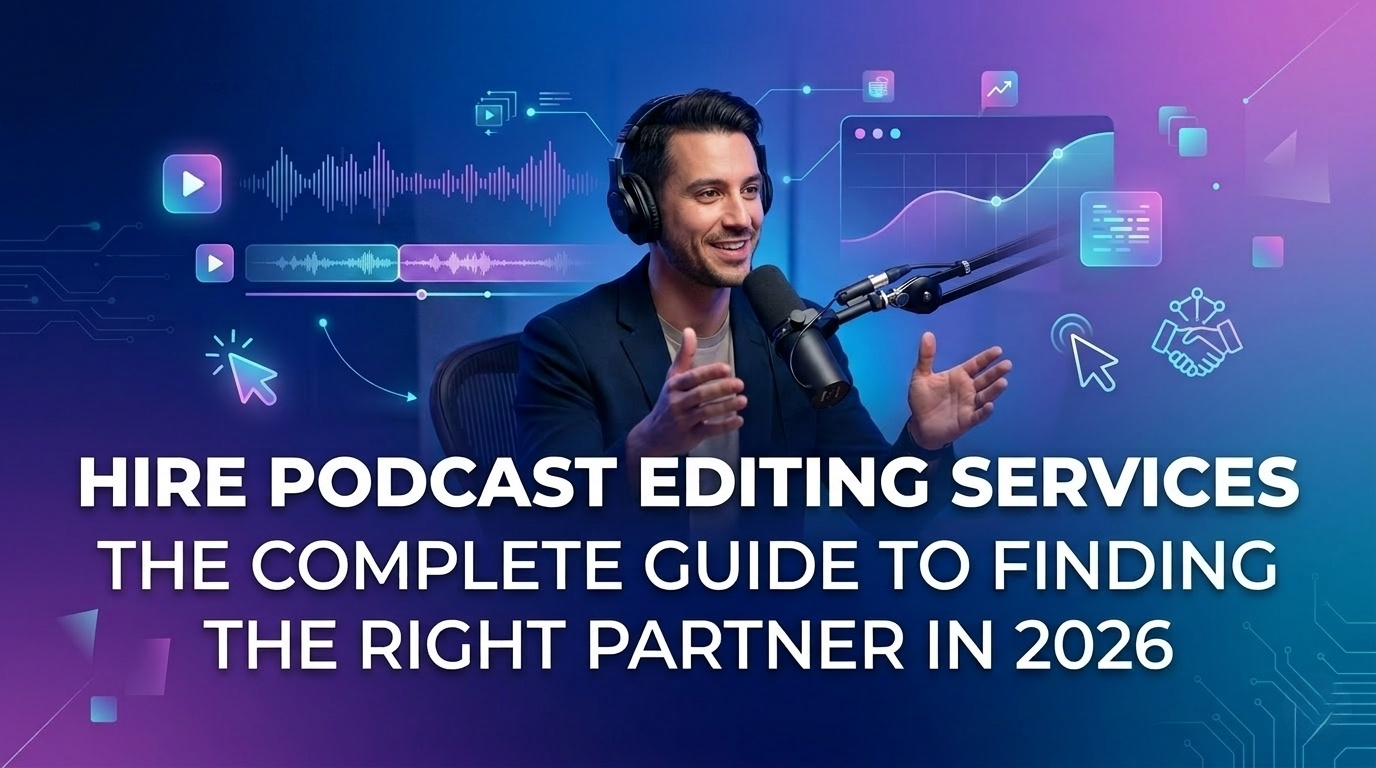
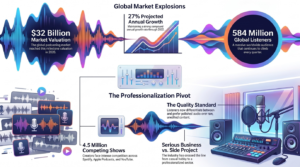
Podcasting has crossed the line from side project to serious business. The global podcasting market was valued at over $32 billion in 2026 and is projected to grow at a compound annual growth rate of 27% through 2032. There are now more than 584 million podcast listeners worldwide, and that number keeps climbing every quarter. With more than 4.5 million shows competing for attention on Spotify, Apple Podcasts, and YouTube, the listeners who stick around are the ones who feel the difference between polished audio and the raw, unedited kind.
That difference is editorial. And if you are serious about growing a show, the smartest move you can make is to hire podcast editing services rather than trying to do it all yourself.
This guide is built for the person who has already decided that outsourcing podcast editing is the right call. You know your time is worth more than learning Audacity. What you need now is clarity: what types of editors exist, how much they cost, where to find them, what questions to ask, and how to avoid the expensive mistakes that most podcasters only learn after getting burned.
Why You Need a Podcast Editor (Not Just Better Recording Gear)
A lot of podcasters fall into the same trap. They spend money on a better microphone, a nicer acoustic panel, a quieter room. Then they wonder why the show still sounds rough. The problem usually is not the recording. It is everything that happens after.
Podcast editing is a discipline that sits at the intersection of audio engineering and storytelling. A skilled editor removes background hum, HVAC noise, keyboard clicks, and electrical interference. They balance volume levels across multiple speakers, fix awkward pacing, remove filler words when appropriate, and shape the episode so the listener never has to work hard to follow along. They add music beds, branded intros and outros, and ensure the final file meets loudness standards for distribution on major platforms.
When you try to do all of that yourself, two things happen. First, you spend hours on post-production that could be spent on outreach, research, or recording new content. Second, because you are too close to your own material, you miss things. A trained editor notices what you stop hearing after the third playback.
In a world where listener attention spans are short and competition is genuinely fierce, poor production is not just an inconvenience. It is a reason to unsubscribe.
The Four Types of Podcast Editing Services
Before you can evaluate a single candidate, you need to know what kind of help you are actually looking for. Podcast editing services fall into four distinct categories, and each one solves a different problem.
1. Technical Editors
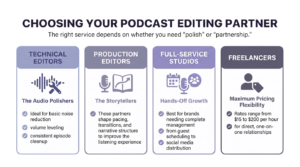
These professionals handle the post-production side of the equation: noise reduction, volume leveling, silence removal, and basic mixing. They take your raw audio and make it sound clean. Some also write show notes and transcriptions. Technical editing is typically priced per audio hour, with freelancers ranging from $30 to $200 per hour depending on experience level. It is the right choice if your recordings are already solid and you simply need reliable cleanup on a consistent schedule.
2. Production Editors
Production editors go deeper. They shape the listening experience. They tighten pacing, fix awkward transitions, balance voices across a conversation, and add music beds, intro stingers, and sponsor reads. They are part editor, part storyteller. If your show has a narrative quality to it or you want each episode to feel intentionally structured rather than simply recorded, this is the type of editing partner you need.
3. Full-Service Production Studios
Full-service studios invest in your show from the ground up. They handle planning, guest scheduling, scripting, editing, show notes, social media clips, and sometimes distribution. They are completely invested in the ongoing success of your show, not just individual episodes. This level of service typically costs between $1,000 and $4,000 per month. It is the right fit for brands, corporations, and serious podcasters who want to treat their show as a proper content asset and need a hands-off operation.
4. Freelance Editors
Freelancers are independent professionals you hire directly through platforms like Fiverr, Upwork, or Twine. They offer the most pricing flexibility: entry-level editors might charge $15 to $30 per audio hour, while experienced specialists command $50 to $200 per hour. The tradeoff is that you take on more responsibility in vetting, managing, and communicating with them. The upside is that when you find the right person, you can build a relationship that results in a consistent style and tone across every episode.
How Much Does It Cost to Hire Podcast Editing Services?
Pricing in podcast editing is genuinely variable, which makes comparing options frustrating unless you understand what you are actually paying for. Here is how the numbers break down across different tiers:

- Basic technical cleanup: $15 to $30 per audio hour. Removes obvious flaws but offers limited creative input on pacing or structure.
- Mid-level freelancers: $30 to $50 per audio hour. More experienced, faster turnaround, better consistency.
- Comprehensive per-episode packages: $100 to $400 per episode. Turnkey solutions that include advanced mixing, custom music integration, and minimal client involvement.
- Video podcast editing: 40 to 60 percent above audio-only rates, due to the added complexity of color correction, captions, and visual synchronization.
- Full-service monthly retainers: $1,000 to $4,000 per month for studios handling strategy, editing, distribution, and content repurposing.
One practical recommendation: when comparing editors, ask for per-episode pricing rather than per-hour pricing. Hourly rates favor the editor if the work takes longer than expected. A per-episode rate keeps your costs predictable and incentivizes efficiency on the editor’s side.
Where to Find Podcast Editors Worth Hiring
Finding candidates is the easy part. Finding good ones takes deliberate effort. The most reliable paths include:
Dedicated Audio Production Firms
Studios like Castos Productions, Resonate Recordings, and We Edit Podcasts maintain teams of specialized editors and established quality control processes. They offer consistent availability, standardized output, and often bundle editing with hosting or distribution services. If you want to reduce vendor management complexity, a production firm is worth the premium.
Freelance Marketplaces
Platforms like Fiverr, Upwork, Twine, and Contra let you browse portfolios, read reviews, and compare pricing directly. They work well when you have the time to vet candidates carefully. Look for editors with substantial ratings, detailed gig descriptions, and response rates above 90 percent. Twine alone lists over 14,500 podcast editors, so filtering by niche experience and turnaround time before you message anyone will save you hours.
Community Referrals
Podcasting communities on Facebook, Reddit, and LinkedIn are underrated sources of qualified referrals. Editors recommended by creators with similar shows tend to bring compatible working styles and a proven understanding of the format. Personal referrals also give you the rare opportunity to hear candid feedback on both strengths and weaknesses before you commit.
10 Questions You Must Ask Before You Hire Anyone
This is where most podcasters underinvest their time. They find someone who sounds competent, they like the price, and they sign on. Then the first few episodes come back late, or the edits miss the tone entirely, and the whole thing falls apart. Ask these questions first.
- Can you show me before-and-after samples? Finished episodes alone tell you nothing. You need to hear what the raw audio sounded like to understand what the editor actually contributed. If they cannot provide before-and-after samples, that is a significant warning.
- Have you worked on shows in my niche? Editing a comedy podcast is completely different from editing a healthcare interview series. An editor who understands your industry intuitively grasps your audience’s expectations, your pacing preferences, and the terminology that should never be cut.
- Walk me through your editing process. A professional editor can describe exactly how they handle noise reduction, leveling, content trimming, mixing, and mastering. If the answer is vague or they tell you to just send the file, you are dealing with someone without a repeatable workflow.
- What are your turnaround times and do you guarantee delivery dates? Inconsistent publishing destroys listener trust and momentum. Agencies that cannot commit to specific service-level agreements are a liability.
- How many revision rounds are included? Get this in writing. Some editors include unlimited revisions; others charge per revision after the first. Know exactly what is covered before the first episode is delivered.
- What audio standards do you master to? Ask specifically about LUFS standards for Spotify and Apple Podcasts. If they do not know what LUFS means, they are not ready to handle professional distribution.
- How will files be shared? Establish the workflow before episode one. Google Drive, Dropbox, and WeTransfer are the most common options. Ambiguity in file handling leads to delays and miscommunication.
- What happens if a guest’s audio quality is poor? This is a practical scenario test. A skilled editor has protocols for salvaging bad audio. Someone without a clear answer is telling you they have not faced this problem enough times to have solved it.
- What is your billing structure? Per episode or per audio hour, monthly subscription or invoice per delivery? Understand the payment terms before signing anything.
- Do you retain any rights to the content you edit? You need full ownership of every edited file. This should be in a written agreement, not assumed.
Red Flags That Should End the Conversation
Knowing what to avoid is just as valuable as knowing what to look for. These are the clearest signs that an editor is not a good fit:
- They cannot explain their editing process in concrete terms. Vague answers like it depends or whatever you want signal a lack of established craft.
- They dodge questions about timelines or revision policies. Both are standard in any professional engagement.
- They skip any conversation about your goals or audience. A good editor wants to understand why your show exists. If they only ask for the raw file and nothing else, you are getting mechanical work, not a strategic creative partner.
- They have no written service agreement. Never work with an editor without a contract that outlines deliverables, payment terms, revision limits, and file ownership.
- They are slow to communicate during the vetting process. If response times are poor before you become a client, they will not improve once you are paying.
Freelancer vs. Agency: Which Is Right for You?
This comes down to what you value more: budget flexibility or operational reliability.
Freelancers are ideal when you are earlier in your podcasting journey, publishing fewer than two episodes per week, and have the bandwidth to manage a working relationship directly. They tend to cost less per episode and can be excellent long-term partners when you find the right fit. Building rapport with a single freelancer over time is also one of the best ways to ensure consistent style and tone across hundreds of episodes.
Agencies are the better choice when scale matters. If you are publishing multiple shows, targeting tight release schedules, or running a podcast as part of a corporate content strategy, an agency provides the infrastructure to maintain quality across increased volume without requiring you to train or manage anyone yourself. Many also offer predictable data-backed improvement, tracking listener drop-off points and audio patterns to help refine content decisions over time.
The worst outcome is hiring an agency-level service when a freelancer would have served you just as well at a fraction of the cost, or trusting a single freelancer with a high-volume, time-sensitive operation they cannot handle. Be honest about your actual needs before you decide.
What a Good Working Relationship Looks Like
Hiring an editor is not a one-time transaction. It is the beginning of an ongoing collaboration. The best podcast editing relationships share a few defining characteristics.
At the start, you invest time in briefing your editor on the flow and feel of each episode type. You explain what degree of editing you expect, whether you want every filler word removed or a more natural rhythm preserved, and what your intros and outros should sound like. You share the brand identity of the show clearly.
After that, the workflow should be largely frictionless. You record, you send the file, they edit, they deliver. Revisions should be specific and rare, not a symptom of repeated miscommunication. Over time, a good editor learns your voice, your guests, and your preferences so well that the feedback loop shortens naturally.
Some of the most successful podcast editors on platforms like Fiverr offer subscription-based arrangements with discounts of up to 20 percent for regular clients. Those arrangements exist because long-term relationships produce better results than one-off engagements. The editor gets context; you get consistency.
AI Tools vs. Human Editors: The Real Answer
AI-powered editing tools like Descript have become genuinely capable in recent years. They handle transcription, automated silence removal, and even basic filler word deletion with impressive accuracy. For low-stakes content or solo shows with clean recordings, they can shave real time off your workflow.
But AI tools do not replace human editors. They replace the most repetitive parts of what a human editor does. The creative judgment involved in shaping pacing, deciding what content to cut for narrative clarity, balancing the energy between two guests, or knowing exactly when a music bed should fade in and at what level, that work still requires a person who understands storytelling. The best services in 2025 combine AI-enabled efficiency for the mechanical tasks with human oversight for the decisions that actually affect listener experience.
If you are choosing between an AI tool and a professional editor, you are not choosing between two equivalent options. You are choosing between partial automation and actual expertise.
The Final Checklist Before You Hire
Use this as your decision framework when you are ready to move forward:
- You have listened to before-and-after samples from at least two or three candidates.
- You have asked for and received a written service agreement covering deliverables, timelines, revisions, payment, and file ownership.
- You have confirmed the editor understands your niche, your audience, and the tone of your show.
- You have agreed on a per-episode rate rather than an open-ended hourly arrangement.
- You have established the file-sharing workflow before sending the first recording.
- You have done a test edit or trial episode before committing to a long-term arrangement.
Closing Thoughts
The podcasting industry is no longer a space where good intentions compensate for poor production. With 584 million listeners and over 4.5 million shows competing for their attention, the audio quality of your episodes is a direct signal of how seriously you take the people listening. When you hire podcast editing services, you are not spending money. You are buying back your time, protecting your brand, and giving your content the professional finish it needs to be taken seriously.
The right editor exists for your show. They understand your format, they work to your schedule, and they make your voice sound exactly the way it should. Take the time to find them properly. The listeners you are trying to reach will notice.